
How to Calculate Fence Panels and Posts
Turn your yard measurements into a sensible first count of panels and posts—then spot the awkward short section before you shop.
By Fence Planner · 2 min read · Updated 2026-07-19
The short answer
Count each straight stretch separately. The planner can estimate the panels and posts, but the last section may need a cut panel or a small layout change.
Why it matters
An 80-foot fence is rarely just “ten eight-foot panels.” Posts take space, gates split a line in two, and corners are shared by both directions.
Do this first
- Choose the fence system you are actually considering and find its installation sheet.
- Add each straight side of your plan separately; place the gate where it will really go.
- Enter the panel or post-to-post measurement exactly as the product instructions describe it.
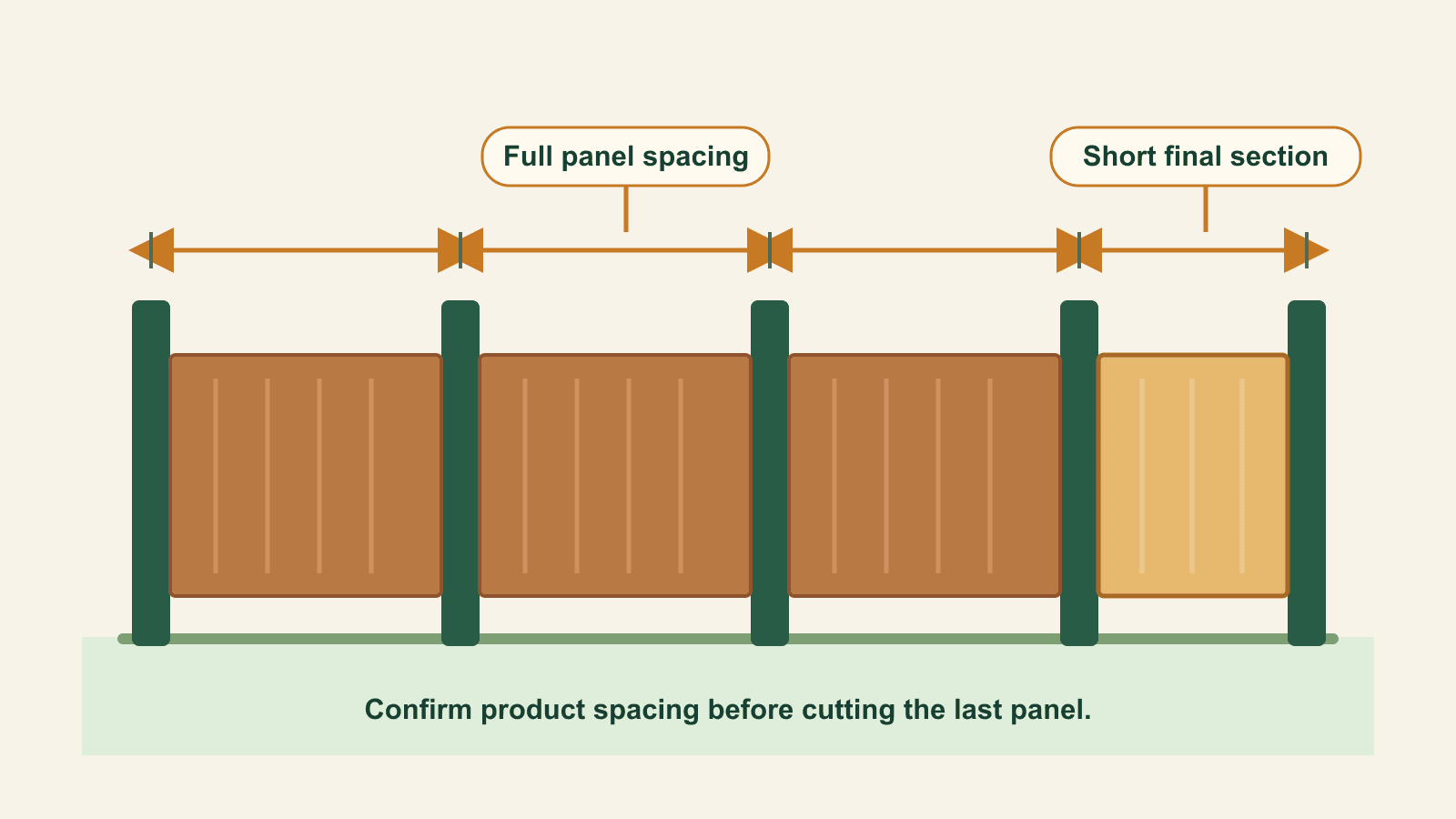
- Look for the final short section. It is normal; it is where a panel may need trimming or the gate position may be worth moving.
Use Fence Planner for this part
It estimates whole panels to buy and shows where the partial section lands. It is a shopping estimate, not a cut list.
How the estimate works
The planner divides each stretch of fence between posts into repeating modules. A module is usually the panel width plus the post thickness, or the full post-to-post spacing your product lists. The leftover short section at the end still needs a whole stock panel for shopping, then a field cut after you confirm the real opening.
Inputs
- Length of the fence stretch with no gate in it
- Module size (panel width plus post, or the product’s post-to-post spacing)
Formula steps
- Divide the segment length by the module size.
- Round up to the next whole number whenever there is any leftover length.
Rounding: Buy whole stock panels. A short leftover still counts as one panel to purchase.
Panels to buy = ceil(segment length ÷ module size)
Open this straight panel-run exampleYou will be asked to confirm before anything replaces your current plan.
Open this gate-position exampleYou will be asked to confirm before anything replaces your current plan.
Panel module explorer
Isolated uninterrupted run only — posts use the panels+1 identity for a single straight run. Field cut width remains product-specific.
- Repeating pitch
- 100 in
- Full panels
- 9
- Final pitch
- 60 in O.C.
- Calculated clear space
- ≈ 56 in
- Panels to purchase
- 10
- Posts (isolated run)
- 11
Final pitch is never labeled as a cut width. Clear space is before product fitting allowance.
Educational planning content only. Not a substitute for local codes, surveys, engineering, or professional advice. See Methodology for how this guide was prepared and how the calculator works.